English
 عربى
عربى Español
Content
- 1 What Makes Automotive Internal High Voltage Cables Essential in Modern Electric Vehicles?
- 2 What Internal High Voltage Cables Do in an EV Powertrain
- 3 Construction and Materials: What's Inside a High Voltage Automotive Cable
- 4 Key Technical Specifications to Understand
- 5 Relevant Standards and Certifications
- 6 The Challenge of Routing and Integration in Vehicle Packaging
- 7 EMI Shielding Performance and Its Impact on Vehicle Electronics
- 8 Selecting the Right Supplier for Automotive HV Cables
What Makes Automotive Internal High Voltage Cables Essential in Modern Electric Vehicles?
As electric vehicles (EVs) and hybrid electric vehicles (HEVs) move from niche products to mainstream transportation, the engineering demands placed on every internal component have intensified dramatically. Among the most critical — and least publicly discussed — components in any EV powertrain is the internal high voltage cable. These cables carry the electrical energy that drives the vehicle, connects the battery pack to the inverter, powers the electric motor, and feeds auxiliary high-voltage systems. A failure anywhere in this network does not just mean a breakdown; it can mean a fire, an electric shock hazard, or a total loss of propulsion. Understanding what these cables are, how they are engineered, and what standards govern them is essential knowledge for anyone involved in EV design, manufacturing, or procurement.
What Internal High Voltage Cables Do in an EV Powertrain
Internal high voltage cables in automotive applications are responsible for transmitting electrical power between the major high-voltage components within the vehicle. Unlike conventional 12V automotive wiring, these cables operate at voltages typically ranging from 400V to 800V DC — and in some next-generation platforms, even higher. The current levels they carry can reach several hundred amperes during peak acceleration or fast charging events, which means the cables must be engineered to handle enormous thermal and electrical stress without degradation over the vehicle's operational lifetime.
The primary circuits that internal high voltage cables serve include the connection from the high-voltage battery pack to the main power distribution unit or junction box, the link between the inverter and the electric drive motor, the cable runs to the onboard charger (OBC), the DC-DC converter connections, and the wiring to high-voltage auxiliary systems such as electric air conditioning compressors and electric heaters. Each of these circuits has different routing requirements, bend radius constraints, thermal environments, and current-carrying demands, which is why EV platforms often use several different cable specifications across the same vehicle.
Construction and Materials: What's Inside a High Voltage Automotive Cable
The construction of an automotive internal high voltage cable is considerably more complex than a standard power cable. Every layer is engineered for a specific function, and the combination of materials must meet demanding requirements for temperature resistance, chemical resistance, mechanical durability, and electrical safety simultaneously.
Conductor
The conductor is the core of the cable and carries the actual current. In automotive HV cables, conductors are almost universally made from stranded copper or aluminum. Stranded construction — using many fine wires twisted together rather than a single solid rod — is essential for flexibility, allowing the cable to be routed through the vehicle's complex geometry and to withstand vibration without fatigue cracking. Fine-wire stranding classes such as Class 5 or Class 6 per IEC 60228 are common, offering the highest flexibility for installation in tight spaces. Aluminum conductors are increasingly used in larger cross-sections where weight reduction is a priority, though they require specialized termination techniques to prevent galvanic corrosion at connectors.
Insulation
The insulation layer surrounds the conductor and provides the primary electrical barrier. For automotive HV cables, insulation materials must withstand operating voltages well above the nominal system voltage to account for transient spikes, meet temperature ratings typically from -40°C to 125°C or higher for under-hood applications, and resist the full range of automotive fluids including coolant, brake fluid, and battery electrolyte. Cross-linked polyethylene (XLPE) and cross-linked thermoplastic elastomers (XLPO or EPCV compounds) are the dominant insulation materials, offering an excellent combination of dielectric performance, heat resistance, and flexibility. Wall thickness is carefully calculated based on the voltage class of the cable, typically conforming to standards such as ISO 6722 or LV 216.
Shielding
Electromagnetic shielding is a defining feature of automotive internal HV cables that distinguishes them from most industrial power cables. The high switching frequencies of modern inverters generate significant electromagnetic interference (EMI), which can disrupt vehicle electronics, communication systems, and driver assistance sensors. A metallic shield — typically a braided copper or aluminum layer, or a foil wrap — surrounds the insulated conductor and is grounded at one or both ends to intercept and redirect this interference. Shield coverage of 85% or greater is standard, with 95%+ coverage specified in performance-critical applications.
Outer Jacket
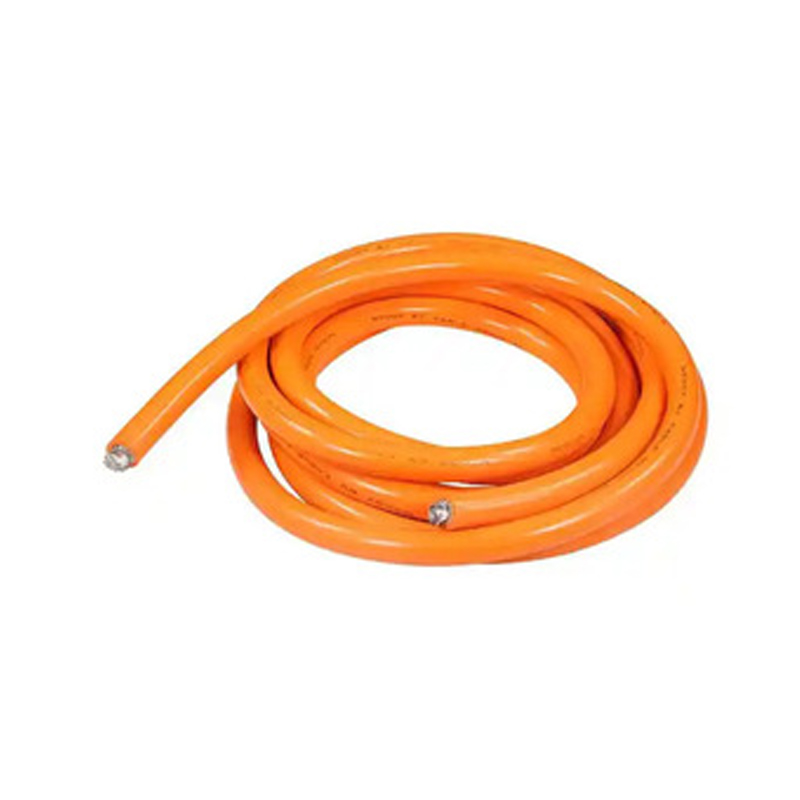
The outer jacket protects the shield and internal layers from mechanical damage, abrasion, UV exposure, and chemical attack. Halogen-free thermoplastic elastomer (TPE) or polyurethane (PUR) compounds are preferred because they combine toughness with flexibility and comply with automotive industry requirements for low-smoke, low-toxicity materials in the event of a vehicle fire. The jacket is typically orange-colored — a universal industry convention for high-voltage components that alerts service technicians to the presence of dangerous voltage levels.
Key Technical Specifications to Understand
When evaluating or specifying automotive internal high voltage cables, a number of technical parameters directly determine whether a cable is suitable for a given application:
| Parameter | Typical Range / Requirement | Why It Matters |
| Rated Voltage | 600V / 1000V / 1500V AC or DC | Must exceed system voltage with safety margin |
| Temperature Rating | -40°C to 105°C / 125°C / 150°C | Must survive underhood and battery thermal environments |
| Conductor Cross-Section | 16mm² to 95mm² (common range) | Determines current-carrying capacity and resistive losses |
| Shield Coverage | ≥85%, often ≥95% | Controls EMI emission and immunity |
| Bend Radius | Typically 5–10x cable outer diameter | Determines routing feasibility in tight vehicle packaging |
| Flame Retardancy | ISO 6722, UL 758, or OEM-specific | Limits fire propagation in a thermal event |
| Service Life | ≥15 years / 300,000 km typical OEM target | Must match vehicle warranty and lifecycle expectations |
Relevant Standards and Certifications
Automotive internal high voltage cables must comply with a combination of international standards and OEM-specific requirements. No single global standard covers all requirements, which means suppliers must navigate a complex regulatory landscape and often maintain multiple certifications simultaneously.
- ISO 6722: The primary international standard for road vehicle cables, covering dimensional, electrical, and mechanical requirements. Part 1 covers cables up to 60V; Part 2 extends to high-voltage cables used in HEV and EV applications.
- LV 216 (German OEM Standard): Developed jointly by BMW, Daimler, and Volkswagen Group, LV 216 defines comprehensive requirements for HV cables used in their vehicles and has become a widely referenced benchmark across the European automotive industry.
- SAE J1654 and SAE J2030: North American standards covering high-voltage primary cable and the general requirements for EV cable systems, widely referenced by US and Japanese OEMs.
- UNECE Regulation 100: The United Nations regulation governing the safety of battery electric vehicles, including requirements for the high-voltage electrical system and its wiring, mandatory for vehicle type approval in many markets.
- IEC 60228: Defines conductor construction classes used in HV cable specifications, particularly relevant for conductor stranding and flexibility classification.
- OEM-specific specifications: Major vehicle manufacturers including Tesla, Toyota, GM, Ford, Hyundai, and others publish their own cable specifications that supplement or exceed international standards. Suppliers must qualify their products against these requirements for each OEM program.
The Challenge of Routing and Integration in Vehicle Packaging
One of the most practical engineering challenges in EV development is physically routing large-cross-section, shielded HV cables through a vehicle body that was often originally designed around a conventional combustion powertrain. HV cables connecting the battery pack — typically located under the vehicle floor — to front and rear motor inverters must traverse the full length of the vehicle, pass through structural members, avoid heat sources, maintain minimum bend radii, and be protected from road debris and stone impacts.
To manage this complexity, OEMs and Tier 1 suppliers develop pre-assembled cable harness systems in which HV cables are pre-cut, pre-terminated, fitted with protective conduit, and bundled with routing clips and brackets before delivery to the vehicle assembly line. These harness assemblies are designed for specific vehicle platforms and can only be installed in one orientation, reducing assembly errors and ensuring consistent routing geometry across all vehicles produced on the line.
The shift to 800V platforms in next-generation EVs from manufacturers such as Porsche, Hyundai, Kia, and Audi adds further engineering complexity. Higher system voltages allow thinner conductors for the same power delivery (since power equals voltage multiplied by current), which reduces cable weight and cost. However, the increased voltage demands even more stringent insulation quality, tighter manufacturing tolerances, and more rigorous high-potential (hipot) testing during production to ensure no insulation defects are present.
EMI Shielding Performance and Its Impact on Vehicle Electronics
Modern EVs are rolling computers. They contain dozens of electronic control units (ECUs), radar and lidar sensors for advanced driver assistance systems (ADAS), multiple communication buses, and wireless connectivity systems for navigation, telematics, and over-the-air updates. All of these systems are sensitive to electromagnetic interference, and the high-voltage, high-frequency switching currents in the EV powertrain are potent EMI sources.
The shielding in HV cables plays a direct role in enabling the vehicle to meet CISPR 25 electromagnetic compatibility (EMC) limits — the standard that governs radiated emissions from vehicles and protects radio reception. Inadequate shielding in the HV cable system can result in EMC failures during vehicle homologation testing, requiring expensive cable redesigns, additional shielding components, or filter elements. Getting the shielding specification right during the initial cable design phase is far less costly than discovering EMC problems late in the vehicle development program.
Selecting the Right Supplier for Automotive HV Cables
The supply chain for automotive internal high voltage cables is dominated by a relatively small number of specialized cable manufacturers with the process capability to consistently produce cables meeting the tight tolerances demanded by automotive OEMs. When evaluating suppliers, the following criteria are the most critical:
- IATF 16949 certification: The automotive quality management system standard is a baseline requirement for any supplier in the automotive supply chain. It ensures systematic process control, traceability, and continuous improvement practices are in place.
- Material qualification documentation: Suppliers should be able to provide full material traceability including compound data sheets, conductor certificates, and test results from accredited laboratories demonstrating compliance with relevant standards.
- High-potential testing capability: Every production length of HV cable should be subjected to 100% hipot testing at the factory to verify insulation integrity before shipment. Confirm that the supplier has in-line hipot testing equipment calibrated and maintained to automotive standards.
- OEM program experience: Suppliers with proven design-in experience on existing EV programs at Tier 1 or OEM level bring validated product designs, known failure modes, and established supply chain relationships that reduce development risk on new programs.
- Capacity and supply security: As EV production volumes scale rapidly, ensuring that a cable supplier has the manufacturing capacity, raw material contracts, and production flexibility to grow with your program is as important as the technical qualification of the product itself.