English
 عربى
عربى Español
Content
- 1 What Is Crosslinking and Why Does It Matter for Wire Insulation?
- 2 How Does Irradiation Crosslink Wire and Cable Insulation?
- 3 How Does Crosslinking Improve Thermal Performance in Irradiated Wire?
- 4 What Mechanical Improvements Does Crosslinking Deliver to Wire Insulation?
- 5 How Does Crosslinking Enhance Chemical and Environmental Resistance?
- 6 How Does Irradiated Cross-Linked Wire Compare to Chemical Crosslinking Methods?
- 7 What Industries and Standards Drive the Use of Irradiated Cross-Linked Wire?
What Is Crosslinking and Why Does It Matter for Wire Insulation?
Crosslinking is a chemical process in which individual polymer chains within an insulation material are bonded to one another through covalent linkages, forming a three-dimensional network structure rather than a collection of independent linear chains. In an uncrosslinked thermoplastic insulation such as standard polyethylene (PE), the polymer chains are held together only by weak van der Waals forces and chain entanglement. When heat is applied, these forces are overcome, the chains slide past one another, and the material softens or melts. This thermal sensitivity sets a hard ceiling on the operating temperature of the wire and creates vulnerability to deformation under sustained mechanical load at elevated temperatures — a phenomenon known as creep.
When crosslinking is introduced, each newly formed covalent bond between adjacent polymer chains acts as a permanent anchor point within the network. The material can no longer melt in the conventional sense — instead it behaves as a thermoset, maintaining its structural integrity up to the point of thermal decomposition. This transformation unlocks a dramatically expanded range of operating conditions for wire and cable insulation, including higher continuous service temperatures, better resistance to short-circuit overloads, improved resistance to chemical attack, and superior mechanical durability over the product's service life. For wire and cable engineers, crosslinking is not a refinement but a fundamental enabler of performance in demanding applications.
How Does Irradiation Crosslink Wire and Cable Insulation?
Several methods can introduce crosslinks into polymer insulation, including chemical crosslinking using peroxides or silane grafting, but irradiation crosslinking — using electron beam (EB) or gamma radiation — offers a set of practical and performance advantages that make it the preferred route for a wide range of wire and cable products, particularly those requiring thin-wall insulation, tight dimensional tolerances, and consistent crosslink density.
In electron beam crosslinking, the insulated wire passes through a high-energy electron beam generated by an accelerator operating typically in the range of 0.5 to 3 MeV. As the electrons penetrate the insulation, they ionise the polymer chains, generating free radicals along the backbone. These free radicals react with neighbouring chains to form carbon-to-carbon covalent bonds — the crosslinks. The process is rapid, continuous, and does not require the addition of chemical crosslinking agents that could affect the electrical properties or chemical compatibility of the insulation. Because the electron beam is applied after the wire has been extruded and cooled, the extrusion process itself is unaffected — the insulation can be formulated and processed as a standard thermoplastic during manufacture and only acquires its thermoset character after irradiation.
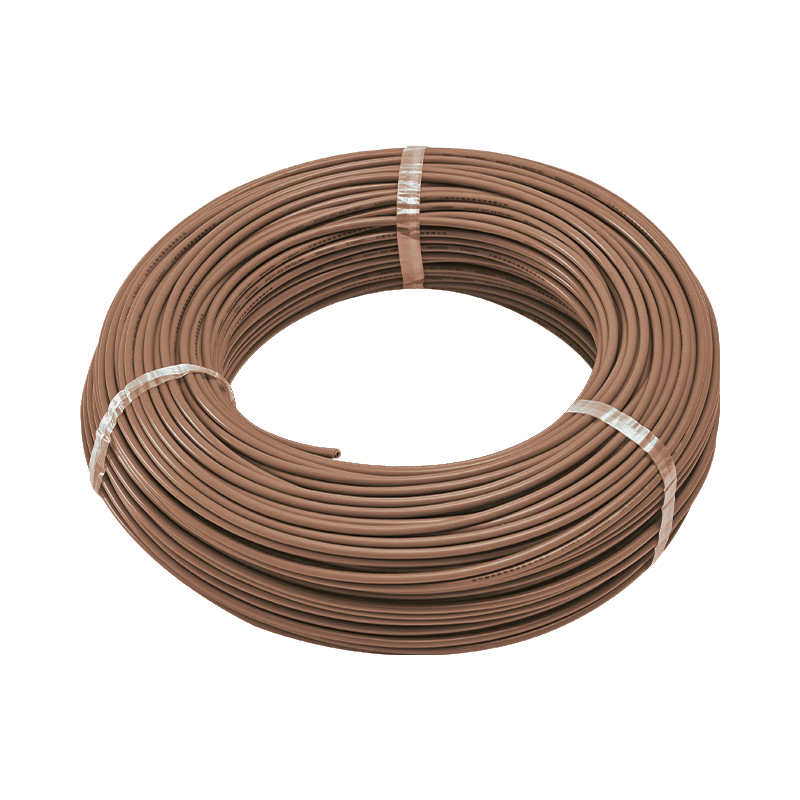
The degree of crosslinking achieved — quantified by the gel content, measured as the percentage of insoluble polymer after extraction in a hot solvent — is controlled by the radiation dose, typically expressed in kiloGrays (kGy). Standard wire and cable applications typically require gel content above 70%, achieved at doses ranging from 100 to 200 kGy depending on the base polymer and any crosslinking sensitisers incorporated into the formulation. Higher gel content generally correlates with better heat resistance, improved creep resistance, and more consistent mechanical properties, though excessive dosing can begin to degrade certain polymer properties through chain scission reactions.
How Does Crosslinking Improve Thermal Performance in Irradiated Wire?
The most commercially significant improvement delivered by crosslinking in wire and cable insulation is the elevation of the continuous operating temperature rating. This improvement directly expands the range of applications for which a given wire construction is suitable and reduces the need for oversizing conductors to manage heat generation at lower current levels.
Standard low-density polyethylene (LDPE) insulation without crosslinking has a maximum continuous service temperature of approximately 70 to 75°C. After electron beam crosslinking to the appropriate dose, the same base polymer in cross-linked polyethylene (XLPE) form achieves a rated continuous service temperature of 90°C, with short-circuit ratings reaching 250°C without insulation collapse. For cross-linked polyolefin compounds with higher-performance base resins, continuous ratings of 105°C, 125°C, and even 150°C are achievable, depending on the formulation and the crosslink density achieved. This stepped improvement in thermal class directly expands the current-carrying capacity of a given conductor cross-section — a cable rated at 90°C can carry significantly more current than the same conductor insulated to a 70°C rating, which has direct implications for system weight, cost, and installation density in space-constrained applications.
The thermal advantage of crosslinking is particularly critical in automotive, aerospace, and industrial wiring harness applications, where short-circuit events, proximity to heat sources such as engines and exhaust systems, and confined routing in hot enclosures regularly expose insulation to temperatures that would cause an uncrosslinked thermoplastic to deform irreversibly. The crosslinked network's resistance to creep — the slow deformation under sustained compressive or tensile load at elevated temperature — ensures that insulation maintains its original thickness and geometry even in compressed runs or under terminal clamping forces over many years of service.
What Mechanical Improvements Does Crosslinking Deliver to Wire Insulation?
Beyond thermal performance, crosslinking produces meaningful improvements in the mechanical properties of wire insulation that translate directly into improved installation durability, longer service life, and better performance in abusive environments. These mechanical benefits make irradiated cross-linked wire a preferred choice in applications involving frequent flexing, abrasion, or installation through conduits and cable trays with sharp edges.
- Tensile strength and elongation at break are typically maintained or improved after crosslinking compared to the base polymer, providing the insulation with the ability to stretch without cracking when the wire is bent around tight radii or pulled through conduit during installation.
- Cut-through resistance — the ability of the insulation to resist penetration by sharp edges, screw heads, or metal burrs in wiring enclosures — is substantially improved by the crosslinked network, which distributes localised stress across a broader area rather than allowing a crack to propagate through independent polymer chains.
- Abrasion resistance improves because the crosslinked surface is harder and more resistant to material removal under repeated rubbing contact with conduit walls, adjacent wires in a bundle, or mounting hardware.
- Cold impact resistance — the ability to survive mechanical shock at low temperatures without cracking — is preserved or enhanced in crosslinked polyolefin formulations, making irradiated cross-linked wire suitable for outdoor installations in cold climates where conventional PVC insulation becomes brittle and susceptible to installation damage.
- Deformation resistance under the pressure of cable ties, clamps, and conduit fittings is improved because the crosslinked insulation recovers its original geometry after the compressive load is removed, rather than permanently deforming, which would reduce the effective insulation wall thickness at the compressed point.
How Does Crosslinking Enhance Chemical and Environmental Resistance?
The three-dimensional network structure created by crosslinking reduces the permeability of the insulation to solvents, oils, acids, and other chemical agents because the network impedes the diffusion of small molecules through the polymer matrix. This improved chemical barrier performance is a critical requirement in automotive engine compartment wiring, industrial control cables routed near process equipment, and marine wiring exposed to fuel, hydraulic fluid, and saltwater spray.
Standard uncrosslinked polyethylene insulation swells and loses mechanical integrity when immersed in hydrocarbon solvents such as diesel fuel or mineral oil. Crosslinked polyethylene is substantially more resistant to these media, maintaining its dimensional stability and electrical properties after prolonged contact. The crosslinked network physically prevents the polymer chains from being separated and solvated by the penetrating molecules, limiting the degree of swelling to a small fraction of the uncrosslinked value. For cross-linked polyolefin compounds formulated with additional chemical resistance additives, resistance to a broad spectrum of automotive fluids — including engine oil, transmission fluid, brake fluid, battery acid, and windscreen wash concentrate — is routinely demonstrated through standardised fluid immersion testing per standards such as ISO 6722 or SAE J1128.
UV resistance is similarly improved in crosslinked formulations that incorporate carbon black or UV stabiliser packages. The crosslinked network reduces surface erosion caused by photodegradation by maintaining cohesion between polymer chains even as surface chain scission occurs under UV exposure, preventing the chalking and cracking that degrades uncrosslinked outdoor cable insulation over multi-year exposure periods.
How Does Irradiated Cross-Linked Wire Compare to Chemical Crosslinking Methods?
Irradiation crosslinking competes commercially with two primary chemical crosslinking methods — peroxide crosslinking and moisture-cure silane crosslinking — and each approach offers a distinct combination of advantages and limitations that influence which is selected for a given wire and cable product.
| Property | Irradiation (EB) | Peroxide Crosslinking | Silane Moisture Cure |
| Wall thickness suitability | Thin and ultra-thin walls | Medium to thick walls | Medium walls |
| Crosslink density control | Precise — dose controlled | Good — temperature controlled | Variable — humidity dependent |
| Chemical additives required | Sensitisers only (optional) | Peroxide agents required | Silane grafting agents required |
| Extrusion process impact | None — crosslinking post-extrusion | Requires controlled high-temp cure | Requires post-extrusion moisture exposure |
| Best suited application | Automotive, aerospace, thin-wall harness | Power cables, medium voltage | Low-voltage power distribution |
The most important practical advantage of irradiation crosslinking for wire and cable production is its compatibility with thin-wall and ultra-thin-wall insulation constructions. Electron beam penetration is sufficient to crosslink insulation walls as thin as 0.1 mm uniformly across the full wall thickness, whereas peroxide crosslinking requires the insulation to be thick enough to retain the heat needed to activate the peroxide and complete the crosslinking reaction during the cure stage. This makes irradiation the only viable crosslinking route for the lightweight, thin-wall insulated wires used in modern automotive and aerospace wiring harnesses where weight reduction is a primary engineering objective.
What Industries and Standards Drive the Use of Irradiated Cross-Linked Wire?
Irradiated cross-linked wire is specified across a broad range of industries and is governed by a well-established body of international and industry-specific standards that define the performance requirements the wire must meet. Understanding which standards apply to a given application is essential for correct product selection and for ensuring compliance with the regulatory requirements of the end market.
- In the automotive sector, SAE J1128 (low-voltage primary cable), ISO 6722 (road vehicle cables), and LV112 (Volkswagen Group standard) define the test requirements for irradiated cross-linked primary wire used in passenger vehicle wiring harnesses, specifying temperature ratings, fluid resistance, abrasion resistance, and conductor construction in detail.
- Aerospace applications are governed by standards including AS22759 (fluoropolymer-insulated aircraft wire), MIL-W-22759, and NEMA WC 27500 (aerospace cables), which require irradiation crosslinking as a specified manufacturing process for certain wire constructions to achieve the required combination of thin-wall insulation, high temperature rating, and flame resistance.
- Industrial wiring applications reference IEC 60227 and IEC 60245 for flexible cables, UL 44 and UL 83 in the North American market for thermoplastic and thermoset insulated building wire, and specific appliance wiring material (AWM) styles listed under UL 758 for internal wiring of equipment requiring elevated temperature ratings.
- Nuclear power applications impose particularly stringent requirements on cable insulation qualification, including radiation resistance testing per IEEE 383 and IEC 60544, where the crosslinked insulation must maintain its properties after exposure to ionising radiation doses representative of the plant's design basis accident conditions over a 40 to 60 year qualified life.
The combination of precisely controllable crosslink density, compatibility with thin-wall constructions, absence of chemical crosslinking agent residues, and the resulting step-change improvement in thermal, mechanical, and chemical performance makes irradiation crosslinking the defining manufacturing technology for high-performance wire and cable insulation across the most demanding sectors of the electrical industry.