English
 عربى
عربى Español
Content
- 1 What Is a Custom Cable Assembly?
- 2 Why Off-the-Shelf Cable Often Falls Short
- 3 Key Decisions in Custom Cable Assembly Design
- 4 Connector Selection and Termination
- 5 Protection and Routing Considerations
- 6 The Manufacturing Process: What a Supplier Should Control
- 7 Certifications and Standards That Affect Custom Cable Assemblies
- 8 Selecting a Custom Cable Assembly Manufacturer
- 9 The Role of Early Supplier Involvement
- 10 A Worked Example: High-Temperature Appliance Wiring
- 11 Cost Drivers in Custom Cable Assembly
- 12 Common Specification Mistakes and How to Avoid Them
- 13 Quality Assurance and Field Performance
- 14 Practical Steps to Get Started
- 15 Conclusion
When procurement sends you a request for a custom cable assembly, the first questions are rarely about price. More often they are: What insulation material for 150°C exposure? Which wire gauge carries enough current without making the bundle too stiff? What connector interface does the mating side use? Those questions decide whether the assembly survives production, passes certification, and holds up in the field. This guide walks through the decisions that actually shape a custom cable assembly, from conductor and insulation choices to connector selection, testing, and supplier qualification.
What Is a Custom Cable Assembly?
A custom cable assembly is a manufactured bundle of wires, cables, connectors, and protective elements engineered for a specific application. Unlike an off-the-shelf power cord or standard hook-up wire, a custom assembly is built to match the exact electrical, mechanical, and environmental requirements of your product. It may be as simple as a two-wire silicone lead with pre-stripped ends, or as complex as a multi-branch harness with sealed connectors, overmolded strain relief, and braided shielding.
The distinction between a cable assembly and a wiring harness matters in practice. A cable assembly usually refers to a single cable with connectors terminated at both ends, often carrying power or data between two points. A wiring harness typically groups multiple wires into a structured bundle, frequently with branching, protective sleeving, and multiple termination points. Your supplier may use the terms interchangeably, but the scope of work, tooling, and testing can differ.
Why Off-the-Shelf Cable Often Falls Short
Standard cables work when the environment is benign and the mechanical interfaces are generic. That is not the case for most original equipment manufacturers. An appliance that generates heat around the internal wiring, a motor that vibrates continuously, or a vehicle environment with heat, oil, and abrasion risk will expose the limitations of commodity cable.
Off-the-shelf solutions fail in four common ways:
- Thermal mismatch: a standard PVC wire rated at 80°C or 105°C sits too close to a heating element, causing insulation softening or premature aging.
- Mechanical mismatch: a stiff, thick-jacketed cable cannot route through a compact hinge or withstand repeated flexing.
- Connector mismatch: the need for a specific connector family, pin count, or wire seal cannot be met by a generic extension cable.
- Certification mismatch: the end product must meet UL, VDE, or CCC requirements, and the wire or assembly itself must carry the relevant approvals.
That is the core reason custom cable assembly exists: to close the gap between a generic wire product and the specific constraints of your device, its operating environment, and its target market.
Key Decisions in Custom Cable Assembly Design
Before contacting a manufacturer, the most useful step is to work through the basic engineering parameters. These decisions drive material selection, cost, and reliability, so they deserve deliberate attention rather than being left to the supplier by default.
Conductor Material and Stranding
Copper is the default conductor material. Tinned copper is common in high-temperature and humid environments because the tin coating resists oxidation and corrosion, which is why many silicone and irradiation-crosslinked wires use tinned stranded conductors. Bare copper is less expensive but more prone to surface oxidation over time, especially at elevated temperatures.
Stranding affects flexibility and fatigue life. A fine-stranded conductor bends more easily and survives repeated flexing far better than a solid or coarsely stranded wire. The trade-off is cost and termination effort. Fine stranding also requires careful stripping and crimping to avoid nicking strands. If the assembly moves during operation, such as in a robot arm or a dishwasher door, prioritize fine stranding and verify the flex life with your supplier.
Insulation and Jacket Materials
Material selection is usually the most consequential decision in a custom cable assembly because it directly determines temperature rating, flexibility, chemical resistance, and cost.
PVC is the workhorse for general-purpose applications. UL1007 and UL1015 cover 80°C and 105°C ratings respectively. PVC is affordable, easy to process, and available in many colors, but it becomes stiff at low temperatures and softens or degrades near its rating limit.
Silicone rubber handles continuous heat well beyond PVC, with many UL silicone wire styles rated at 150°C, 200°C, or higher. Silicone is also extremely flexible, which makes it suitable for routing in tight spaces and for applications involving motion. The softer surface can abrade more easily, so protective sleeving or braided silicone constructions are worth considering in high-wear areas.
Crosslinked polyethylene, often labeled XLPE or XLPO, offers a good balance: higher temperature ratings than PVC, better mechanical toughness than silicone, and thinner wall thickness for the same voltage rating. Irradiation-crosslinked wires such as UL1430, UL3173, or UL3321 are common in appliances, lighting, and electrical equipment where flame retardance and heat resistance are required.
PTFE and FEP fluoropolymer insulations provide the highest continuous temperature capability, typically around 200°C, along with excellent chemical resistance and low outgassing. They are used in demanding environments where the extra cost is justified by reliability requirements.
Voltage Rating and Wire Gauge
Voltage rating determines insulation thickness, but it is rarely the factor that drives wire size. Current-carrying capacity, acceptable voltage drop, and mechanical strength drive gauge selection. The assembly manufacturer can recommend a gauge once you define the current per circuit and the allowable temperature rise, but the responsibility for the final calculation should be shared between your engineer and the supplier, particularly if the wire bundle is tightly packed.
When current is high but the route is short and vibration is present, the mechanical property of the wire can become more important than ampacity. A thick, coarse-stranded wire may be too stiff for the routing path. This is one of the reasons custom cable assembly exists as a discipline: it balances electrical, thermal, and mechanical demands rather than selecting wire from a single datasheet.
Connector Selection and Termination
Connector selection is the second half of the custom cable assembly equation. The same wire specification can perform very differently depending on the connector, terminal crimp, and strain relief used to terminate it.
Start with the mating interface. If your device connects to a proprietary port or an industry-standard connector family, the decision is already constrained. The remaining variables are contact finish, wire entry angle, locking mechanism, and sealing requirement. If you have full freedom, choose a connector with a proven track record in your industry plus availability across multiple sources.
For high-temperature environments, verify the connector housing and contact insulator are rated for the same temperature as the wire. A silicone wire rated at 200°C connected to a nylon housing rated at 105°C creates a weak point that defeats the purpose of the wire selection. Similarly, crimp the correct terminal, preferably with the manufacturer-specified tooling, and inspect the crimp height. Poor crimping causes intermittent failures and overheating at high current.
Strain relief is the most overlooked termination detail. The point where the wire enters the connector or the enclosure is the natural stress concentration location. Overmolding, heat-shrink tubing, and grommets all serve this purpose. Without proper strain relief, flexing and pulling will eventually break conductors or stress the crimp joint, regardless of how well the wire itself is specified.
Protection and Routing Considerations
Once the wire and connectors are selected, think about how the assembly will route through the final product. Heat-shrink tubing at termination points protects the exposed wire strands near the crimp. Sleeving, such as woven fiberglass or silicone-coated fiberglass, adds abrasion resistance and a further thermal barrier in high-heat zones. A braided silicone construction can be specified from the start for higher mechanical durability in an already flexible wire design.
Environmental sealing matters for appliances exposed to moisture, such as bathroom heaters, smart toilet lids, and vacuum cleaners. Water ingress at the connector interface is a common field failure. Sealed connectors, potting, or conformal coating on the PCB end are available options, but they add cost, so the decision should follow the actual IP rating target of the final product.
The Manufacturing Process: What a Supplier Should Control
Custom cable assembly is not just about combining the right wire and connector. The manufacturing process determines whether the engineering specification is actually realized. A reliable supplier controls conductor stripping, crimping, soldering, molding, and testing as individual process steps with measurable criteria.
Cutting and Stripping
Precision cutting ensures length consistency. Stripping must remove the insulation without nicking the conductor strands. Nicked strands may survive initial testing but fail later due to flex fatigue. For fine-stranded wire, the difference between a good strip and a bad strip is visible only under magnification, which is why reputable manufacturers perform pull testing and periodic microsection analysis.
Crimping and Soldering
Crimp quality determines contact resistance and mechanical retention. A properly crimped terminal deforms the barrel around the conductor and insulation in a controlled manner. Tensile pull force and crimp height are the two standard controls. Soldering, when used, requires temperature control to avoid wicking insulation or creating brittle joints.
Assembly and Protection
During final assembly, wires are routed into the connector housing, protective sleeving is installed, and strain relief is molded or attached. The human element matters here: clear work instructions, visual aids, and quality inspections reduce the risk of miswiring or reversed polarity. A single reversed wire in a connector can cause a field failure that is difficult to trace.
Testing and Traceability
A 100% electrical test is the industry baseline for custom cable assemblies. Continuity, insulation resistance, and dielectric withstand are the core checks. Whether you need a full hi-pot test depends on the application; appliances that connect to mains power should have it. Traceability matters when your product enters service and needs root-cause analysis. Ask the supplier about Lot trace codes, batch records, and how they handle nonconforming material.
Certifications and Standards That Affect Custom Cable Assemblies
Certification is not a decoration; it is the legal and practical gateway to selling your product in a given market. Wire and cable products are commonly certified under UL in North America, VDE or TUV in Europe, and CCC or CQC in China. Your assembly supplier does not need to certify every wire in-house, but the wires they use should carry the approvals your final product requires.
For the European market, compliance with the Low Voltage Directive and RoHS and REACH restrictions is expected. For North America, UL-recognized components are normally required for end-product safety certification. For China, CCC certification applies to certain wire and cable categories, while CQC covers others. When the final product is an electrical appliance, the internal wiring must match the temperature, voltage, and flammability ratings expected by the relevant appliance standard.
If your supply chain requires alignment with automotive quality practices, an IATF 16949-certified supplier brings additional discipline in risk analysis, change management, and production part approval. That certification does not change the wire specification, but it changes how the supplier documents and controls their process.
Selecting a Custom Cable Assembly Manufacturer
Manufacturer selection is about matching capability with the actual risk profile of your product. For a high-volume appliance maker, the supplier must demonstrate experience with appliance internal wiring, solid process control, and competitive cost. For an automotive or industrial customer, the priority shifts to system-level quality management and traceability.
A manufacturer with in-house wire extrusion and harness assembly offers practical advantages. They control the material spec and wire quality from the start, which shortens communication and reduces the chance that a third-party wire lot goes out of specification. Companies like Jiangyin Zhijun Appliance Electric Cable and Wire Co., Ltd. produce both insulated wire and finished wiring harnesses under one roof, which matters when custom cable assembly projects require tight coordination between wire selection and harness assembly.
When evaluating a supplier, ask about their quality system certificate, the standards their products carry, and whether they have experience with your specific application. A useful starting point is a direct conversation about a typical installation: the exact wire rating, connector style, shielding or sleeving requirement, and testing protocol. The supplier’s responses to those specifics reveal more than any generic marketing claim.
Lead time and minimum order quantity are practical constraints that should be negotiated with full transparency. Custom assemblies often start with a prototype phase, followed by pilot production and mass production. Confirm whether the supplier supports each phase and what the turnaround is for each sample iteration.
The Role of Early Supplier Involvement
Waiting until the product design is frozen to approach a cable assembly manufacturer is a common mistake. By then, routing space constraints, connector choices, and thermal budgets are already fixed, often forcing compromises in the very area where the cable assembly must perform. Involving the manufacturer early lets you validate the wire gauge against available routing space, cross-check the connector temperature rating against the environment, and request a more flexible or more durable construction before the tooling is cut.
Early involvement also gives the manufacturer room to suggest moulded strain relief designs, different wire stranding, or a more cost-effective certified wire style that still meets the requirement. Their recommendations often come from having seen failures of similar assemblies in the field, experience that is hard to replicate in a buyer’s internal engineering team. Even a single discussion during the concept phase can prevent a costly redesign later.
A Worked Example: High-Temperature Appliance Wiring
Consider a countertop air fryer. The internal wiring near the heating element must tolerate sustained temperatures well above 105°C, and the routing path is tight. A reasonable specification starts with a silicone-insulated wire rated at 150°C or 200°C, using a tinned copper conductor fine-stranded enough to follow the routing path without stress. The connections to the heating element require a high-temperature terminal and a heat-shrink or sleeving transition to protect the crimp area. The harness then runs to a control PCB, where the connector housing temperature rating must match the wire temperature rating at the connection point. Each decision is connected: the route determines the strand count, the heat source determines the insulation, and the PCB connector determines the termination format.
The same logic applies to a bathroom heater, an induction cooker, or a motor lead connection. The specifics differ, but the sequence is the same: thermal environment, mechanical routing, current load, termination, and certification. The discipline of custom cable assembly is not about exotic materials; it is about closing each of those gaps deliberately. Air fryer high-temperature control harnesses illustrate how these requirements are realised in a production part.
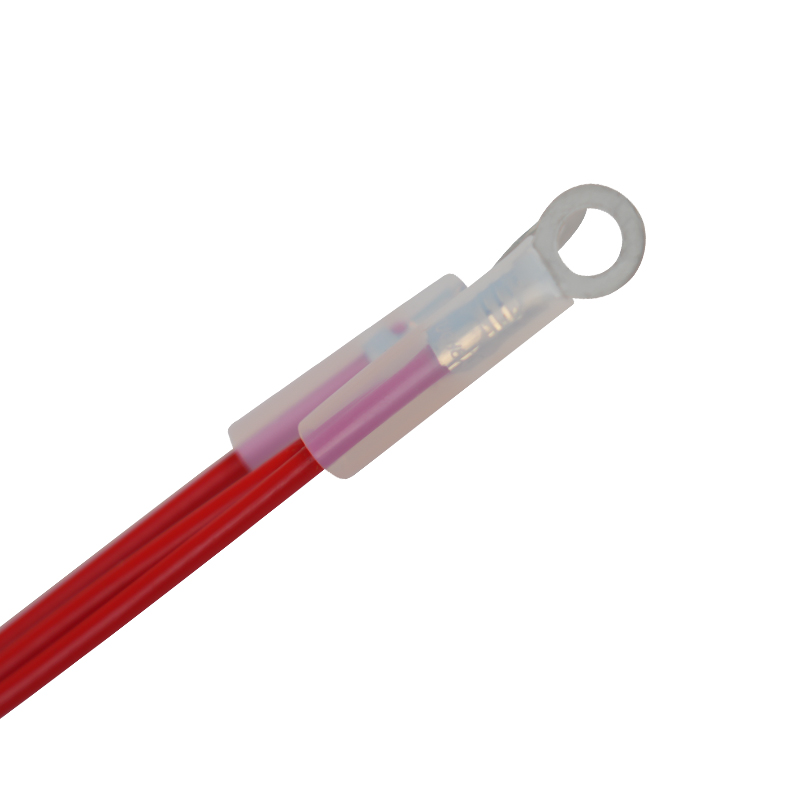 Air Fryer Wiring Air Fryer High Temperature Control Harness Suppliers, FactoryJiangyin Zhijun Appliance Electric Cable and Wire Co.,ltd is China Custom Air Fryer Wiring Air Fryer High Temperature Control Harness Sup...View Product →
Cost Drivers in Custom Cable Assembly
Cost is a function of material complexity, process steps, and quality requirements. A simple PVC internal connection wire with a standard connector moulded on one end is a low-cost item. The price rises with high-temperature insulation, fine stranding, multiple connectors, overmoulding, and higher testing standards.
Wire gauge drives material cost directly. Specifying a heavier gauge than necessary increases copper cost and bundle stiffness without any functional benefit. The same applies to insulation thickness: a 600 V-rated wire in a 50 V application may be unnecessary if the voltage rating is not driven by the end-product standard.
Connector quality also matters. Branded connectors from established manufacturers cost more but reduce supply risk and issue rates. Custom tooling for a proprietary connector adds an upfront investment that makes sense only at sufficient volume. For smaller runs, choosing a standard connector family avoids tooling cost and shortens lead time.
Testing requirements are the other visible cost component. A basic continuity and hi-pot test is inexpensive, but 100% pull-force testing and automated dimension inspection add time. Decide which tests matter for the failure mode of your application. An automotive customer may want a full PPAP package; an appliance customer may only need a certificate of conformity. Both requirements are valid, but they are not priced the same.
Common Specification Mistakes and How to Avoid Them
Most custom cable assembly problems originate from the specification stage. The most frequent errors seen by manufacturers include:
- Over-specifying the temperature rating without considering the actual ambient temperature plus current rise, which increases cost and reduces flexibility.
- Selecting a connector before confirming the wire entry direction and space available behind the panel, forcing routing compromises later.
- Ignoring the temperature derating of the connector housing, which fails first even though the wire was correctly specified.
- Assuming that a thinner wire is always better for routing, without accounting for the mechanical strength needed at the termination point and the pull force applied to the assembly.
- Skipping the prototype phase for a critical harness, then discovering a routing or fit issue only in production.
A good practice is to fill out a cable assembly specification sheet before contacting suppliers. Include the number of circuits, the current per circuit, the voltage rating, the continuous and peak temperatures at each routing segment, the minimum bend radius, the connector types at both ends, the ingress protection requirement, the certifications needed, and the expected annual volume. Suppliers can then give you a realistic quote and identify contradictions in the specification, such as a 200°C environment combined with a connector rated for 105°C.
Quality Assurance and Field Performance
Field failures in cable assemblies are rarely caused by a single dramatic event. Most result from cumulative thermal aging, abrasion, flex fatigue, or a micro-crack in a crimped terminal that was not caught at production. The reason quality systems matter is that they increase the probability of catching a defect before the assembly ships.
For the buyer, the practical quality signals are existing certifications, process documentation, and the discipline with which the supplier handles change requests. A manufacturer that immediately updates the engineering drawing when a wire gauge changes and sends the revised drawing before producing is far more reliable than one that simply runs the order and hopes the old drawing still applies.
When the product involves high-temperature exposure, the choice of insulation material becomes a safety issue. PVC softens and may degrade when exposed above its rating; silicone withstands high temperature but smoulders without proper flame-retardant formulations. The material datasheet alone does not tell the full story; the supplier’s experience with certification bodies and with field performance across different applications provides a more realistic picture.
Practical Steps to Get Started
If you are at the early stage of specifying a custom cable assembly, the path is straightforward:
- Document the electrical, thermal, mechanical, and environmental requirements for the assembly.
- Identify the target certifications for the end product.
- Select candidate wire types and connector families from a trusted manufacturer’s catalogue.
- Ask the cable assembly manufacturer for samples built to your specification, then test them in your actual application.
- Review the manufacturer’s quality certificates and factory audit results before committing to a volume order.
For further technical background, articles on how home appliance wiring harnesses improve safety and reliability and how to choose high-temperature wire cover the underlying principles from an application perspective. Most suppliers are also willing to discuss a design review if you bring a rough specification.
Conclusion
Custom cable assembly does not need to be complicated, but it does need to be intentional. Define the operating environment first, then select the conductor, insulation, connector, and protection strategy that match it. Choose a manufacturer that controls the full process, from wire extrusion to final testing, and that engages early enough to prevent redesign loops. The cheapest assembly is not the one with the lowest purchase price, but the one that passes certification the first time and runs through the field without a recall. That reliability starts with the decisions made before the first sample is ordered.